
When most people think about 3D printing, they picture the outside of an object. The finished product sitting on a desk or coming off the print plate. But what many don’t realize is that what’s happening inside a print is just as important as what’s on the outside.
That hidden interior is called infill.
Infill is the internal structure that supports a 3D printed part. Instead of printing an every object as a completely solid block of plastic, most prints contain a repeating pattern inside that provides strength while reducing print time and material usage. By changing the infill pattern and density, designers can customize a print based on how it will be used.
Not Every Print Needs to Be Solid
One of the biggest misconceptions about 3D printing is that a stronger part simply requires more plastic.
In reality, that’s rarely the case.
At the Innovate Marquette Protolab, our team selects infill based on the purpose of each print. A part printed at 100% infill isn’t dramatically stronger than one printed at around 40–50% infill, but it does require significantly more material and takes much longer to produce.
Different Patterns for Different Jobs
Just as different tools serve different purposes, different infill patterns excel in different situations.
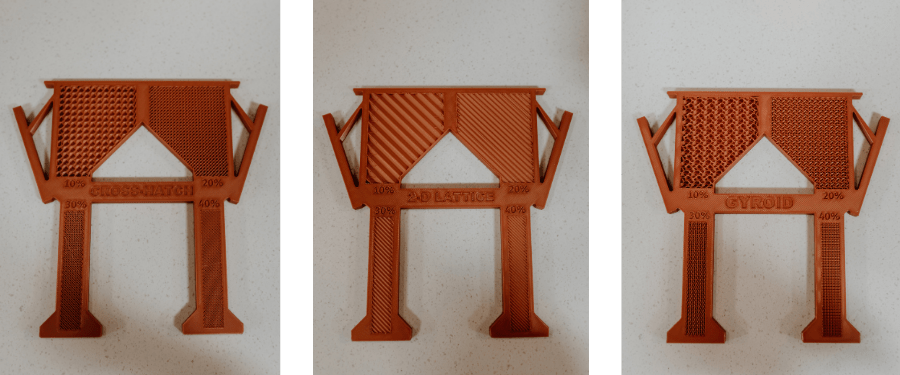
Grid: Grid infill is one of the fastest and most common patterns used for everyday prototyping. Its straight lines allow printers to move quickly while providing reliable strength for general-purpose parts.
Triangles: Triangle infill creates a rigid internal structure that performs well when a part will experience force from a single direction. It’s often chosen when a design is ready for functional testing or stress testing.
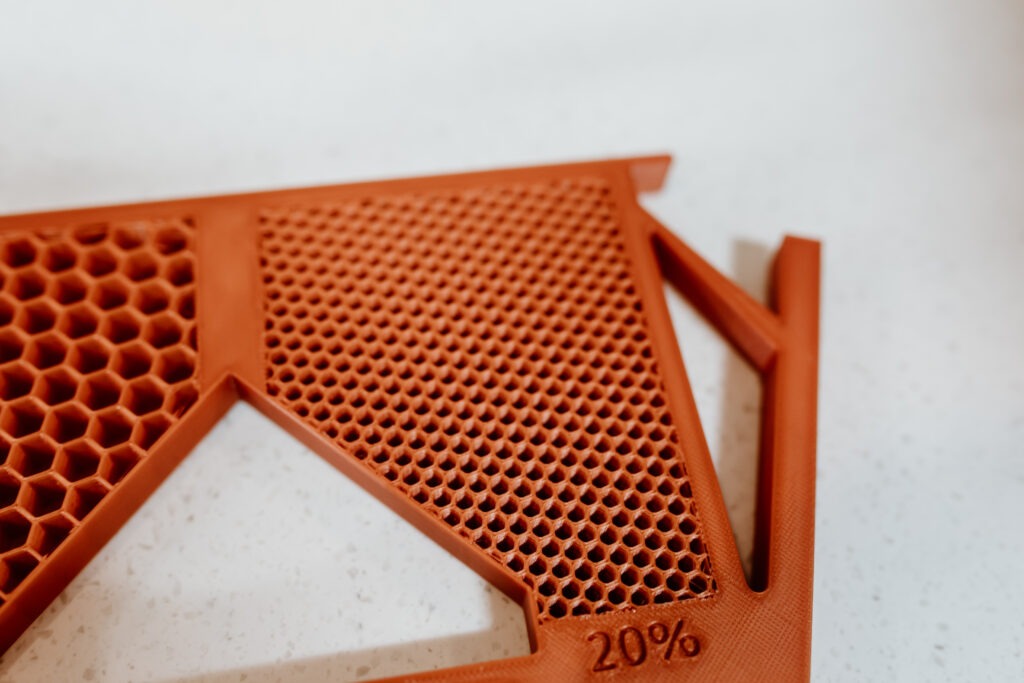
Honeycomb: Recognizable by its hexagonal pattern, honeycomb provides excellent strength in a single direction while maintaining an efficient weight-to-strength ratio. It’s a great option for structural parts that need added durability.
Gyroid: Gyroid has become one of the Protolab team’s favorite patterns because of its balanced performance. Its continuous three-dimensional structure distributes forces from multiple directions, making it a great choice for functional parts with unpredictable loads. When in doubt, gyroid is often the default choice.
Lightning: Unlike the other patterns, lightning infill isn’t designed for strength. Instead, it creates just enough internal support for the top layers of a print while using minimal material. This makes it ideal for decorative models where speed and efficiency matter more than structural performance.
Orientation
The strength of a 3D printed part depends on more than just the infill.
Because 3D printers build objects one layer at a time, each layer creates a natural seam within the part. Much like wood has a grain, 3D printed objects have a preferred direction of strength.
Imagine a wooden board. It’s much easier to split along the grain than across it. The same concept applies to 3D printing. By changing how a part is oriented during printing, the Protolab team can dramatically improve its ability to withstand real-world forces.
Whether we’re creating a proof of concept for an entrepreneur, a functional prototype for testing, or a finished product for manufacturing, choosing the right infill is an important part of the design process.
It’s one of the many decisions our Protolab team makes to ensure every print balances strength, efficiency, print time, and material usage.
The next time you pick up a 3D printed object, remember: what you can’t see is often doing most of the work.